Communication devices (AAC)
Augmentative & alternative communication for people who use more than speech.
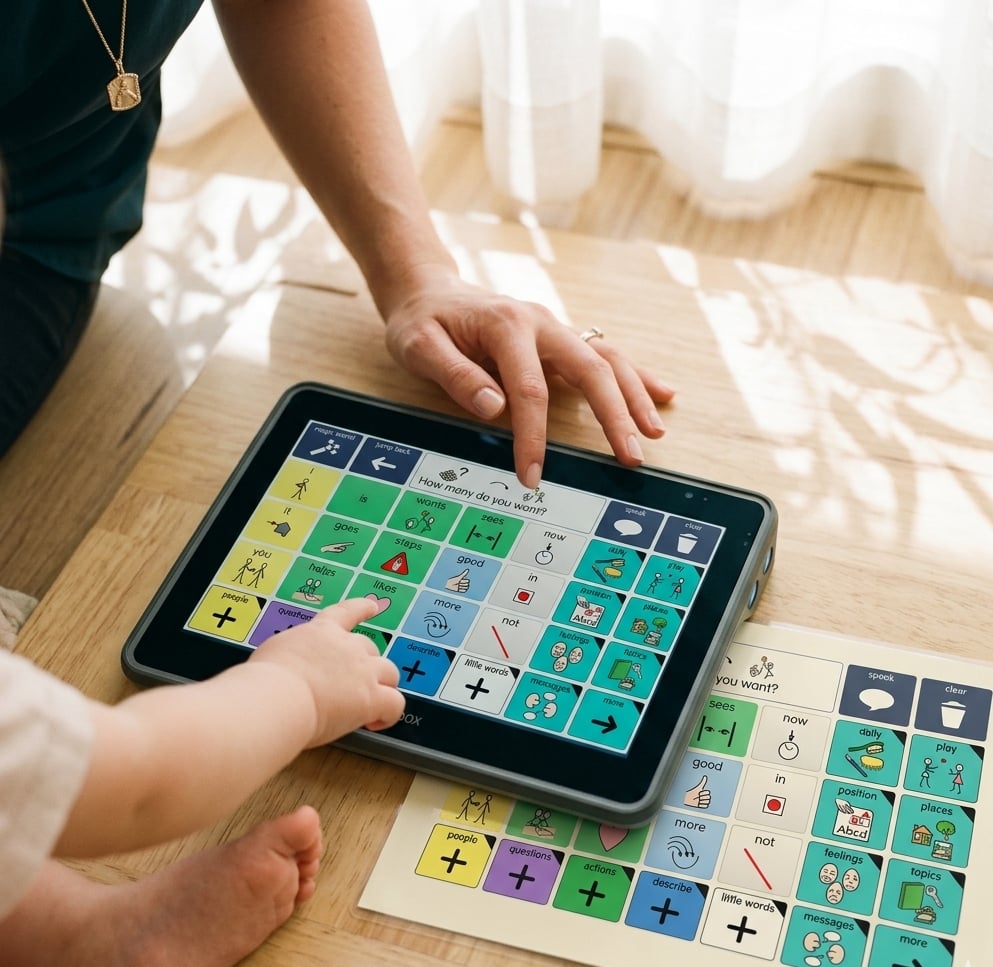
AAC — Augmentative and Alternative Communication — is any way of communicating that isn’t only spoken speech. That includes signs and gestures, picture boards, communication books, and dedicated speech-generating apps like Proloquo2Go or TouchChat on an electronic device.
Who AAC is for. Children and adults who find speech hard, slow, or unreliable. That’s a wide group — autistic kids who are pre-verbal or minimally speaking, children with apraxia of speech, people recovering from a stroke, people living with motor neurone disease or cerebral palsy. AAC is not a “last resort”. Research is clear that using AAC does not slow speech development — for many children, it speeds it up.
What we do.
- Fit assessment. Which system suits the person? Low-tech first (picture board, book) is often the right place to start; high-tech comes in when the vocabulary needs are bigger.
- Modelling. We teach families and educators to use the AAC system themselves so the child sees their communication tool used in conversation, not just handed to them in therapy.
- Vocabulary growth. We add words to the system as the person’s life changes — new school, new friend, new interest.
We can liaise with electronic-device funding through NDIS where relevant, and we run trials with the device before recommending purchase so you can see what works.
Sound like a fit?
Send a short enquiry — someone from our team will be in touch within 1–2 business days.
Enquire